
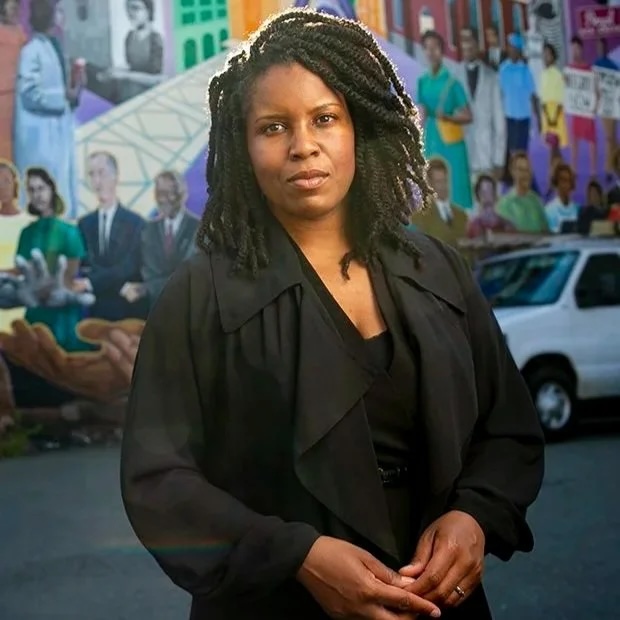
Democracy Works host Candis Watts Smith joins Cara Santa Maria on the Talk Nerdy podcast to discuss her new book, Black Evidence: A History and a Warning.
From Reconstruction to Redemption, from the enactment of landmark civil rights legislation to the execution of the Southern strategy, from 2020’s multiracial protests to the swift elimination of policies etching out a more inclusive society, Americans regularly experience periods of racial reckoning followed by walloping retrenchment.
In Black Evidence, Smith shows that this pattern is the result of an American habit: denying the truths about our society that Black people experience and remember. Smith then delivers a warning: the effects of this habit ripple out, dulling our ability to identify the signs of authoritarianism and heightening our tolerance for cruelty. Still, she shows how these same truths offer models to overcome our repeated predicament.
Talk Nerdy host Cara Santa Maria is a clinical health psychologist, science communicator, podcaster, and Emmy Award-winning journalist. In addition to Talk Nerdy, she co-hosts the Skeptics' Guide to the Universe podcast and coauthored Skeptics Guide to the Universe book.
This article is sourced from the Democracy Works podcast. Listen or subscribe below.
Where to subscribe: Apple Podcast | Spotify | RSS
Scroll below for transcripts of this episode.
Cara Santa Maria
Hello, everyone, and welcome to Talk Nerdy. Today is Monday, April 6, 2026 and I'm the host of the show, Dr Cara Santa Maria. And as always, I want to thank those of you who make Talk Nerdy possible before we get to the meat of the show. As I say, every week talk nerdy. ISM will always be 100% free to download, and the way that we keep this show going is by relying on the support of individuals just like you. We use Patreon as our mechanism for that. If you're interested in pledging your support on an episodic basis, all you've got to do is visit patreon.com that's P, A, T, R, E, o n.com/talk nerdy. This week's Top patrons include Chuck BLE David J E Smith, Daniel Lang, Mary Neva, Will defrain, David Compton, Brian Holden, Gabo J Ulrica, Hagman, Pasquale Gelati and Joe Wilkinson, thank you all so, so very much. All right, let's dive into it. So this week, I had the opportunity to have just a wonderful and illuminating chat with Dr Candis Watts Smith. She's a professor of political science at Duke University, and she's written several really interesting books and CO written them. She wrote the history of politics and race in America from 1968 to the present. She co wrote racial stasis, and also stay woke. And recently she wrote, or I guess, the most recent before this book, she wrote, sorry, black mosaic, the politics of black Pan Ethnic Diversity, which we will talk about a little bit on the show. But she has a new book out. It's called Black evidence, a history and a warning. And I think there's kind of a great top line right as you dive into the book. It says a fierce expose of American resistance to believing black people and its devastating effects throughout history, that is what we're going to get into today. So without any further ado, here she is. Dr Candis watts, Smith, well, Candace, thank you so much for joining me today.
Candis Watts Smith
It is a pleasure to be with you.
Cara Santa Maria
I'm excited to talk about your new book, black evidence, a history and a warning, and before we get into that history and that warning, I, as I often do, would like to ask you a little bit more just about yourself, about your career, about what brought you to this book. So you're a professor of political science at Duke. But I'm curious, did you study poli sci all the way up through? Did you do any like, African American studies or other kind of degree paths and then combine that multidisciplinary view? How did you get to that place?
Candis Watts Smith
Yeah, yeah. So I it's probably a series of non decisions. So I started undergrad as a first gen student, and I think I accidentally took a bunch of poli sci classes, and then you're like, Oh, I guess I should do this. And along the way, I studied international comparative studies in Arabic. And then I learned that I was someone told me that I was good at poli sci so I just kept going. And I stayed and stayed. I mean, I've been to other departments. I've been to departments of public policy, African American Studies, Black Studies, I'm trying to think, are there others? And, you know, no so those. And mostly because, you know, faculty, professors get to study what they want, and some people will just kind of focus on one issue, one question and dive deeply on that question for their whole career. I just don't have the attention span for that. So most of the research that I do are around questions of inequality, but I mostly just kind of choose to go. In directions that interest me at the moment, things that stand out to me, contradictions that keep arising, that kind of gnaw at me. And poli sci allows me to do that.
Cara Santa Maria
I love that. And I mean, when we think about political science, it is sort of a broad brush, like, how would we even, I mean, gosh, I think to somebody who maybe is not very academic, or who never took any poli sci courses, how would you define poli sci? Because it can kind of include things like public policy, even international relations. There's some sociology involved, maybe even some economic some government, like, what kind of aspect of political science? Well, I know you just said you jump around a lot, but, but what kind of what components of political science, I guess, attracted you, and where within that world do you tend to operate?
Candis Watts Smith
Well, I mostly focus on individual behavior and identity and how that intersects with people's political preferences. I'm mostly interested in why people have such a high tolerance for inequality, and so I spend a lot of time in that space. So like you said, political science has lots of different components, philosophy, international relations, comparative analysis across governments and institutions, and then many of us study kind of individual behavior and identity, and that's where I sit, mostly because people are just so weird. And for a long time I said, you know, make this joke like, oh, as long as people are acting crazy, I'll have a job. But now I just, I'm like, everyone, just sit down and be quiet. Okay, if I don't have a job studying, you know, the rise of inequality and the rise of white nationalism and Christian nationalism. And I wish, I, I wish I didn't have to study those things. I wish none of us did.
Cara Santa Maria
Yeah, you know, previously, you, you, you co authored two books, stay woke and racial stasis. But you also authored black mosaic, the politics of black pan, ethnic diversity and and, you know, it's interesting. I'm, I'm reading a little bit about it this kind of, not just intersectionality, but diversity within sort of black America. I have one of my dearest friends. I remember her always correcting people when they call her African American, because she's Afro Caribbean. She was born in Panama, and she's like, I live here now, but I'm not African American. And so she obviously preferred, not obviously, but she prefers the term black. I found myself using the term black more often as an umbrella term, so as not to kind of misidentify somebody. But I love this idea of like, obviously, we should be having conversations about diversity within quote, unquote racial groups. I mean, whatever that even means. And I'm curious kind of, what brought you you wrote this book over a decade ago, what brought you to black mosaic, and then maybe the difference between between this new book Black evidence, because there's a lot of time in between the two.
Candis Watts Smith
So Black mosaic came out of my dissertation work and some of my undergrad work. I am more or less from North Carolina, and where I live, North Carolina, the South for most of its history, I think people would kind would, would have characterized the demographics as black and white, and then maybe a little something else, you know. And when I came to college, I start meeting all these black people that were not from the States, or that their parents weren't from the States. And I remember this one woman saying to me, like, oh, wait, well, where are you from? And then you ask, Well, where are you from? From North Carolina. My parents are from Chicago. Their people are from Mississippi. And she said, Oh, it's really fascinating that you've accomplished all that you have, and you're like, just an American. What? You're just an American, black person. And Her idea was, like, black immigrants are exceptional, or that my achievements must have been from a particular culture, and she just could not have imagined that, you know, that my family were many generations American, and so that was one of those moments where you're like, Oh, this is there's a whole thing going on here. Um. And so that's how I ended up writing black mosaic. Was from that conversation. And over the years, we've heard more and more about you know, when you go to Harvard and Princeton and Yale, that when you walk on campus and you meet the black students there, they are largely of immigrant stock, that their parents are immigrants, or that they're immigrants. And so, you know, there's all these questions about, why is that, and what's going on. And so those kinds of questions, those you know, like, Oh, that's interesting. What's happening here? What are the dynamics here? Interests me. And now, you know, people are looking at, you know, the 2024 election, and they're saying, Well, why did so many black men in particular vote for Trump? And that, I think that question actually tells us more about the question asker than about black folks, which the question asker is assuming that black folks should behave a certain way, should think a certain way, and should have a certain set of priorities, when in fact, the demographics, the kind of characteristics of Black folks, have changed significantly over the past 20, 30, 40, years, and if we don't keep up with the complexity of any group. I mean, same with Latinos, right? Oh, why did so many Latinos vote for Trump? Well, who are you talking about? Which groups are you talking about. We have this kind of very flat way of talking about these groups, and then we get surprised when it turns out that there is more to any particular group than anyone assumed in the first place.
Cara Santa Maria
Yeah, yeah. I mean, it's it's such a tough thing when we think about assumptions about individuals who are always obviously intersectional and who always have different life experiences, different priorities. I remember kind of having an insight into this early on in my career as a public science communicator, when I went to a women's scicomm Like symposium, and, you know, one of the first things that was said was kind of like, we are not monolithic. We're not going to agree about everything, just by virtue of our gender. And at the same time, you know, I believe, and I'm curious your take on this, that there is some validity to the, I guess, maybe concern or the surprise when individuals vote for people who appear to fundamentally, I guess the right word would be, hmm, I'm struggling with the right word here. Who fundamentally deny their existence and their value. You know what I mean? Like, like, it is, I think, of somewhat valid question to say, like, why would black men vote for Trump? Or, like, Why would women vote for Trump because Trump is racist. He is a white supremacist, he is a misogynist.
Candis Watts Smith
But he's also anti immigrant, and so are some Black people, and he's also, he's anti Black, and so are some women, and he's also, you know,,
Cara Santa Maria
So what is that priority exactly most around thing to them, that's, right, yeah, oh, it's, it's, it's fascinating. But, of course, now kind of moving a decade later. I mean, obviously that's like, more relevant than ever. But even I would say, Maybe I shouldn't say more relevant, but incredibly prescient and and apropos of our time is, is black evidence a history and a warning? Because, of course, what we're talking about here the idea of black evidence of black truth, of black existence, of black voices and the cultural tendency, the Civic tendency, the policy and and government tendency, but even the personal tendency to deny black existence, to say, No, I know what is really happening here. I don't actually need to listen to your you know, experience to understand that is so pervasive in our culture,
Candis Watts Smith
Yes, and you know, when I just was having a conversation with my friend Blair about just watching the 2020 protests after George Floyd's murder, I was like, why are people so up in arms? Now, this is not anything new, right?
Cara Santa Maria
How did that reach an inflection point?
Candis Watts Smith
Yeah, like, I'm, you know, I am at a loss for how, on some level, I'm at a loss. Or an understanding of why we cannot get our minds around the fact that Black people have been saying that this is a real possibility every day, all of the time. And I study, one of the other things that I study is policy and and there's a there's a theory in policy that says that policy shapes politics, and it shapes our behavior, and it shapes what we think, and we tend to historically believe and trust our policymakers. So if a policymaker makes a policy that says people in prison can't vote over time. People say, Oh, okay, yeah, that makes sense. Like a person they you know, they're doing their time. They get these rights revoked. That makes sense.
Candis Watts Smith
I mean, it doesn't should. It doesn't make sense.
Candis Watts Smith
But we've made it make sense, and so just upon reflection of our history, it's like, oh, well, what are the policies that would have shaped these habits of disbelief, of dismissal, of evasion, of gaslighting? That's the only thing that can help me make sense is that we just have a habit of ignoring the insights that our fellow citizens give to us on a regular basis.
Cara Santa Maria
Yeah, it's sort of like I think about the way, you know, as a psychologist, I guess I approach this, you know, through, obviously, the lens and the perspective of of my training and my area of interest and and it kind of makes you wonder, how do human beings choose which voices to say, Well, that's an authority on this issue. That is somebody who I do believe, versus Oh, that's anecdotal, or that is an exception to the rule, or that's weak evidence, or that, you know, story there is, is not as valid. And it does seem to be the case that phenomenal logic data, right? I did a dissertation. Was a, was a existential, hermeneutic, phenomenological exploration of medical aid and dying, where I interviewed people who were choosing to die with medical aid, and I really dug deep into their personal experience, and tried to do what I could to see their choices through their eyes and to strip away as much bias as I could, or actually, I didn't strip it away. I identified it, highlighted it, and became aware of the bias that was present. And that's a really interesting practice that I had never done before my dissertation, and it gave me a lot of insight into the fact that we just don't do that very often in society, we don't look at individual experience as a valid form of evidence.
Candis Watts Smith
I think that's true, and I think and for some people, more than other people. So to your point, that we have stereotypes and ideas about who is a figure of authority, who is likely to tell the truth, whose testimonies are worthy of consideration, and and vice versa. I think it's really fascinating. This work that you did, it was also probably really hard for you to do it right. Right? I mean, it's hard to listen. It's hard to to get into someone else's shoes and say, Oh, I see where you're coming from. And it's especially hard if that the person that you are, the person's testimony who you know you're listening to implicates you or implicates your group in some shape or form, and that makes it even more difficult. And so I'm not, you know, trying to get anyone off the hook here, but what I am noting here is that I'm not saying that it's easy to hear black folks say, here are the reasons why we have why we have a democracy in crisis, that these are the things that we've done to ourselves and each other, and you've earned these privileges because of those things. That's hard to hear, but it, you know, it, it doesn't mean that we shouldn't listen for it.
Cara Santa Maria
Yeah, you know, I think, I think you make an important point here that bears digging into a little bit more, which is sort of like the, how do I even word this? The two sides of the um. And perspective mirror. So you've got the person who is making the determinations, who is thinking, and you've got the person whose experience is being shared. And we live in a culture that, even though demographically, is not necessarily white majority, at least in many, you know, parts of the country, it from a power perspective, it's a white supremacist, white majority culture. And you know what I'm curious about is that sort of experience of the other, the experience of the how do I put myself in somebody's shoes, if I don't have their lived experience like I am a white American, cis woman, I am Puerto Rican. That's my ethnicity, but my race. You know, I'm putting in air quotes, but that is how we often define demographics on census data. I work in a hospital. You know we list race and ethnicity. My race is white. I present as white. I that affords me all the privileges that come with my with my white skin, I do not know what it is like to be black in America, except by talking to my black friends and colleagues and reading books and having conversations. You know, I cannot exist as a black person in America, but I can listen to black experience. And my concern is that very often, as you mentioned before, this is the point that that I want to dig deeper into when I talk to, you know, a black American, and they say to me, your whiteness is contributing to this problem. It is my role to sit with that, to figure out how I feel about that, and to continue on in spite of that, maybe because of that, to reckon with my own racial identity development, see where I am in that process, and to integrate it. And so that's a big part of the work that I try to do in, you know, anti racist conversation and anti racist identity. But for a lot of people, their immediate reaction is defensiveness, and so how like do you think that is really the crux and at the core of why Black voices are so often minimized and undermined is that because the people in a position of power, they hear, Oh, it's my fault. Well, f you. I'm not gonna accept that.
Candis Watts Smith
I think it's multi dimensional. I think there is some of that it is hard to hear. You know, there's these, you know, we're having a conversation about meritocracy. Nobody who has gotten their college degree from a fancy college wants to believe that they didn't deserve that degree or that they that something else other than their own hard work got them into their you know, their college as an example. So so you know, if you're hearing things that say to you, that turns out that the story that you've been telling yourself is a lie, I think that's that's hard to hear, but I do think that there's also on, on the other side is that there's just a habit we there are certain things that we do that we don't even think about them when we're doing them. Someone starts singing the or says the Pledge of Allegiance. Your hand goes straight to your heart. It's not even a thought. You just do it. There are certain you see a red light, you stop. You know, there are all these kinds of everyday habits that we have built over the course of our lifetime, over the course of history, and I think this is one of them that you see a group of folks that, I mean, can give you a lot of inconvenience. Inconvenient truths, and we have habits. And I say we Americans, generally speaking of dismissing some groups readily, I would say almost by habit.
Cara Santa Maria
Yeah, and like, I guess we can't really ignore that there is a intentionality, a nefarious hand, a historical agenda that's been very policy driven behind some of those habits, right? That like they're reinforced because somebody, and many people, want them to be but that doesn't necessarily mean that in that moment, it's part of the calculus at all. I think that's why you have this sort of new group of, quote, anti woke, very often, sort of manosphere. Are white men who are overtly racist and overtly misogynistic, trying to sort of minimize the argument of historic disenfranchisement, trying to minimize the argument of people living in, you know, certain parts of cities today, people you know, experiencing systemic racism, systemic disenfranchisement. This is the culmination of of these historical wrongs you have these sort of loud, outspoken people who are basically saying, like, nope, shit was hard in the past for everybody get over it. We're all kind of in an egalitarian society now, and if you're struggling to get into college, that's your own fault. It has nothing to do with where you grew up or what you look like.
Candis Watts Smith
That's exactly right, so it but even in this case, you we have a policy that now makes the kinds of behaviors to exclude, okay, and and that just, you know, attitudes will justify your behavior. So, you know, I think sometimes about, you know, like, Okay, we had slavery in the United States, which was a really horrific era. And there's a lot of things that we know that I mean, just the abuse, the violence, the terror, anything I thought to myself, like, how that is not like a thing that people are born they don't wake up, you know, they're not born into wanting to abuse other people, and not in that kind of gruesome way. And in writing this book, what I learned is that there was a policy that said, you know, white folks, or soon to be white folks, you all don't understand that this system of slavery that we're having is for profit driven motives, and you all do not know how to be good masters, and so we are going to make a policy that not Only constrains the behavior and movement of enslaved Africans, but it will also dictate to you what your behavior should be in via those people. So if you don't keep your enslaved person under control, we will punish you, right? And over time, that becomes you're doing it because the policy says to do it, but now you're you have to have a series of attitudes that justifies your behavior, and then that can go on and on, all by itself. I think it's similar to what we're seeing now. We have a president that comes in and says that dei policies are illegal, discriminatory policies, which justifies a behavior to, I don't know, fire 300,000 black women, and now you have to have an attitude that justifies this. They didn't deserve it in the first place, right?
Cara Santa Maria
Right? It's, it's this sort of post hoc reasoning that happens once you are deep in something that you don't even realize is happening as it's happening. And I think what's so kind of, you know, it's Nuremberg, right? It's like I was just doing what I was told. It's, it's such a perfect example of the cognitive gymnastics that I think we all have to go through in effort to to minimize our own cognitive dissonance in this life, because cognitive dissonance is uncomfortable, right? If I'm thinking two things at the same time, and one is that I'm justified and I'm doing the right thing, and the other is that this is unethical, and I'm gonna, you know, rot in hell for this, or, like, somehow downstream this is gonna, you know, get me karmically or even just it doesn't feel good to do this thing that feels cruel. We will often go with the justification and the psychological explanation that is the most palatable to us. And I am, you know, obviously concerned that this negative feedback loop, as you described it, right? Because it begets itself and it starts to run away from itself. That's how we end up with authoritarianism. That's how we end up in the crisis the you know. Of kind of democracy that we're in right now, right?
Candis Watts Smith
That and the fact that we I don't want to say that we don't value critical thinking, but we also have a series of policies that suggest that critical thinking expertise is not the way to go. So cognitive dissonance in this case, right? Is like, Ooh, I'm doing this thing, and I I believe myself to be a good person, but this thing is the wrong thing. It sounds like it's unethical. I'm going to solve my cognitive dissonance by just saying that I'm a good person. A critical thinker would say, Well, how did we get into this spot in the first place? And then it that's a different set of questions that we would try to answer, which is, maybe you are a good person and maybe you didn't know better, but this is the system that we have, and it's unfair. Now, what are we going to do about it?
Cara Santa Maria
And that's a that's an important place that I think a lot of people are sort of waking up to right now, you know, sort of this. I gosh, I mentioned this at least, like once a month on the show. But I think about the Beverly Tatum quote in Why are all the Black Kids Sitting Together at the cafeteria, this idea that, you know, white supremacy, white identity. Well, supremacy. I mean, I can't think of a better way to put it. It really is this moving sidewalk that we see at the airport, right? And if you are just kind of standing still, you're still moving in the direction of those policies. You have to turn around, you have to walk backward, and you have to walk faster than the sidewalk is moving forward in order to actually break that chain. And I think a lot of people right now have been standing still on the sidewalk, and they're they're waking up to Trump's reality, and they're going, oh shit, what can I do? I've just been being pulled along, not realizing how their own sort of actions have perpetuated because the systems are in place because those policies exist.
Candis Watts Smith
I think in this case, I am in agreement with you. I think that one of the things that people are seeing now is that the thing that's on the other side of the walkway doesn't is going to eat them alive as well.
Cara Santa Maria
Right? Yeah, they themselves are also subject to it, you're right until it matters to me, it doesn't actually matter, and that's gross, but it's also the reality, right? Like it's one thing to watch my fellow person and that fellow person being of a different ilk, a different race, a different color, a different whatever. It's another thing to see that, oh, wait, these policies, wait, now I'm included in that minority standing Oh, now my left wing, you know, ideology is being eaten alive. Now my womanhood, or my my social class or my, whatever the case may be, that's I'm so glad you pointed that out, because I do think that's really the impetus
Cara Santa Maria
It's an important point. You know, it's we got to look ourselves in the mirror and see that. It's kind of, you see it all the time with, like, celebrities or with, I mean, I know this is not a great example, but you know, somebody doesn't care about an issue until their kid has the disease, and then all of a sudden they're the spokesperson for the disease. Like, that's what we're talking about here.
Candis Watts Smith
Yeah, I mean. But the thing is, is and right? What is infuriating is that it takes so much when we've been told so if we cared about democracy, democracy says that, like, everyone gets a say. And so then you're like, Oh, well, okay, maybe this policy means that some of those people don't get a say, but that same policy rule system can be used against you. And so we, we, we chip away at. The foundations by allowing some groups to be sacrificed, to be excluded, to be, you know, left out. But we need everyone to be involved in order to have, you know, strong community, a strong society, a strong democracy, to stay away from authoritarianism, you know? And so the thing is, is that I, I guess I would argue that we have been on the decline for a long time. It's just now that people are seeing where they sit in the in the in this disaster, dumpster fire that we find ourselves in now,
Cara Santa Maria
Absolutely, and I think that's why it's so freaking important that we study our own history like I can't help but think about books that I've read about suffrage, and how you know, really, when you dig into suffrage, you see that suffrage was not just about The right for women to vote, but that the front line individuals in this fight were black and queer women, and that there was a lot of infighting, there was a lot of sort of white gatekeeping. Saying, no, no, you guys are not going to be good for our cause. We don't want to have anything to do with you. Please let the white, you know, kind of ladies take take up the and it's like, what are you even talking about? The whole point is that if we don't all fight for these rights, eventually they will be eroded, like they, you know, every punk rock song, first they came for the queers, then they came for the blacks, and they, soon they're gonna come for you. Like, this is how you have to think, and it's how all of history has told us this works. I mean, even the Holocaust, right? Like, it wasn't just the Jews, and it wasn't just the Romanian, it wasn't just the individual, you know, and the and the LGBTQI we look at like Weimar, Germany, like, but a lot of people, they have a very oversimplified view of their of their own history. And of course, how would you not if that is what is being taught in your schools because of these policies?
Candis Watts Smith
Yeah, yeah. I mean, it's we practice on smaller groups. But those tools can be used, can be scaled up very easily, if, if they are, let, let, let to be so,
Cara Santa Maria
Yeah, and Trump is such a kind of almost overt and obvious example, in some ways a beautiful metaphor for what we're talking about, because even within his own ranks, I mean, we had a whole administration of his to learn from, and of course, now it's always been off the rails, but now it's like All the quiet parts are being said out loud, but not just in terms of like American you know, interest groups, or like demographic groups, or, you know, just intersectional identities, but look at his own inner circle. It's like he does it to the people who thought that they were Trump's team, yes, and the in the circle just gets smaller and smaller and smaller.
Candis Watts Smith
It's it's really fascinating to watch, isn't it? I mean to insult, you know someone who you selected to be in your inner circle?
Cara Santa Maria
Yeah, someone who stumped for you. He will turn on Vance just like he turned on pence. He will turn on everybody the minute that narcissistically they insult him. And that's that's really what supremacy and and, you know, power grab is about, right? Yes, and that's why this black evidence. I mean, obviously, like you mentioned, it's always multifaceted. But I can't help but feel like, as you strip away and strip away and strip away, it's always gets down to capitalism, to money, to power.
Candis Watts Smith
Yes, I mean,
Cara Santa Maria
I mean even the roots of slavery, right? And the and the systems and the policies that you said were in place to kind of punish or get, you know, white enslavers into line. It's sort of this idea of like, nope. This is what is economically viable for the ruling class. So we need to, we need to shape up and make, make sure that we stay the course.
Candis Watts Smith
Yeah. I mean, yes. I think my pause there. I was thinking about the white folks who actually only benefit psychologically and so, you know, oh, right, yeah, category
Cara Santa Maria
Who vote against their own entry. Yeah.
Candis Watts Smith
It's like, okay, that's not going to feed your family. But sure.
Cara Santa Maria
But I think sometimes when you really dig into it, and you get down to it, and you hear them defending billionaires. It's because they truly believe that one day they could be rich. That's correct. They're like, correct.
Candis Watts Smith
Yes, it's not happening for you, bro.
Cara Santa Maria
But of course, it kind of makes sense that somebody who denies that they're you. Isn't an even playing field. Somebody who denies systemic discrimination and racism is obviously going to believe that the American Dream applies to them and that the it is a will issue. It is a pull yourself up by your bootstraps issue and like their time is coming. It's funny, there's a theme that's been coming up for me in the other podcast, I work on the skeptics guide to the universe and in therapy with my patients lately. So I work in a in a Cancer Center at, like, a big hospital and and work with patients who are going through, you know, treatment and and beyond. And a theme that I've been seeing over and over is the fundamental attribution error, right? This cognitive bias that tells all of us when something good happens to me, it's because I'm a good person. When something good happens to you, it's because you happened upon it. And really, that's the opposite of it. The real one is when somebody's like an asshole when I'm driving, it's because they are just an asshole, but when I'm an asshole when I'm driving, it's because I'm late, and it's situational, yes, yeah, we all have that, right? Like, that's a, that's a human way of thinking that we have to actually, actively break, yeah?
Candis Watts Smith
And I just trying to think about that on the aggregate level. So I think the way that plays out is kind of around this, this knee jerk reaction to the idea of white privilege. Yeah, right. Like, that's what that is.
Cara Santa Maria
I sometimes wonder if I should be using that word, because people often stop listening the second I say,
Candis Watts Smith
Yes, yes, yes, yes, yeah. I think that's in that category. That would be the group version of the fundamental attribution error, which, yeah, we don't. You know, I'm a low income white person, I don't, I don't have privilege, but that's not what that means anyway. And so and so. Then people are here like, Okay, I won't use that word, even though it is the word to use to describe the situation, absolutely. So, you know, I think about, we end up boxing ourselves in in some kinds of ways, in response to people's and, you know, you want people to listen like you're you want to craft your communication for your audience. But we also, I think, are finding ourselves in this situation where we can't, we can no longer use the words that do the best describing because the people whose feelings are hurt matter more than telling the truth of the matter.
Cara Santa Maria
Oh, okay, I have to share like an experience that I had. I would say it would be about three years ago now, because I really want your take on the I wish I knew you then and could have called you and said, Please help me in this moment, because, you know, based on all of your expertise, I'm at a loss. So obviously, I live in LA I grew up in Texas. I did my internship for my psychology PhD in Florida at a private university in a an outpatient Gerontology center, and I had an incredible supervisor who was very existential and who is anti racist and probably the most liberal person within the whole department that I was, you know, privileged to work with the students that We worked with came from all different walks of life, right? It was Florida, and they were who they were, and they were training to be psychologists, and I had a group of graduate students that I was overseeing as the intern, and we read for our book club how to be anti racist. And I remember the initial reaction of one of the students, who was a white woman, saying, This is not how to get through to me. I do not want to be insulted. I do not want somebody to yell at me. If you want me to hear this perspective, you shouldn't sound so angry about it. I felt myself being very defensive the whole time I read this now I respected the fact that she shared her honest experience, that she felt defensive, and she was sort of able to find it inside herself to say that, but I struggled, and I kind of was was at odds with my supervisor of how to handle it, because my supervisor was very patient, and would ask, you know, open ended questions, and would really kind of hold the hands of some of these students and bring them along for the ride. And my perspective was, these students are seeing patients. Now, I do not feel comfortable allowing somebody who has that perspective. Safe to see a patient like catch up. You need to catch up. If this is the work you want to do, it is unsafe for you to be this behind in your understanding of sort of racial identity. And we were at odds with that. And part of it was probably my California perspective, I don't know, but I'm curious your take on that, because I think we see this in academic institutions a lot. We see this sort of white, as you mentioned before, I don't know, not denial, yes, but almost like reactivity to being told that they have privilege, but we see it in academia. We see it in medicine. We see it in places where it can do real harm.
Candis Watts Smith
Yeah, you know, the thing is, is that I'm not sure that I would have disagreed with your mentor
Cara Santa Maria
You are a better woman than I
Candis Watts Smith
Well, because what I'm thinking about is strategy.
Cara Santa Maria
Yeah, you were being actually logistic in your approach, which is, which is a smart way to be,
Candis Watts Smith
Yeah, I mean, and I'm with you. Like, if someone's like, oh, I don't like this. It's i It makes me feel defensive. I mean, in my mind, I'm thinking like, so the fuck what? Get past it. But I have also been trained as a Black woman living in the society that there are folks that you have to deal with with kid gloves, right? If you want to get the thing out of them, you have to know the language. And you know, actually was going to mention this earlier, when we were talking about, you know how difficult it is to be in someone else's shoes, but I think that is what black folks do in order, right?
Cara Santa Maria
You exist in white spaces all the time.
Candis Watts Smith
So there so, so I think it's it would be hard for me to jolt out of that. I mean, I know what my my inner dialog would be screaming on one side, but as a, as a, as a person who is trying to bring people in, I think I would end up going the long. What makes you say that? Can you let's talk about values. Let's see if we can untangle the contradictions here. Can I get you to think more critically about what you're saying and what that means and but that's my my strategy, because that's the strategy that has allowed me to live in the way that I live now.
Cara Santa Maria
Yeah, and I think a lot of it, it sounds like has to do with role. Right at the time, I was still a student, but I was an advanced student, and they were students who were not as advanced in their education, but I wasn't in that sort of supervisory Professor position, and I didn't have the insight and the wisdom and the knowledge, and there was a part of me that felt angry, like I'm doing the work. Why? Why aren't you doing the work? You know? And I think I see that a lot in my everyday experiences with loved ones from a feminist perspective, like, I don't want to have to teach men to be better to women, it's exhausting, and I feel like that's not my job. And I hear this all the time from my black friends, right? Like I don't want to be patient with white racist people, like it is the most insulting, infantilizing, exhausting thing to be asked. But of course, a sometimes you just have to, as you mentioned, like that is the position you have been put in. B, you are a professor, you are a political scientist, and you get to see it from both sides. And it's such a curious thing to me, just the burden what we ask of people to where the onus falls when it comes to teaching, and that's why, I think getting back to the whole point of this book, right, black evidence, a history and a warning is, you know, why is it the job of Black Americans to go above and beyond to try to prove that their simple existence is valid.
Candis Watts Smith
It's not our job.
Cara Santa Maria
Yeah, exactly. But then you carry the burden, right? You so often carry the burden. That's the part
Candis Watts Smith
You know. My son is 12. He's in seventh grade, and he has our. Already learned that he hates group work because there are free writers and there are people who do not care. And he is thinking, I want to do well on this assignment. I want to earn whatever benefits, you know, I want to do the learning, all of the things, and so I am going to pick up the slack here, because I want to move, you know, I want us to do well. And so it's not his job to carry his team on his back, but that is the position that he's put in, and it's similar, right? We're in a group where you have a group assignment here, and it is moving our society towards its better angels. It's bending the long arc of history to justice, you know, all of these things. And it's also about survival. And so that means that some of us are going to pick up the slack, because our lives depend on it, because democracy depends on it, because having nice things for everybody or for as many possible people depends on it. So, you know, I think that's the answer. It's not our job, it's everybody's job. It's just that some people show up for work.
Cara Santa Maria
Yeah, and the truth of the matter is, I think it also, you know, I think in a way, it validates to the black folks who decide I don't want to do this. It isn't psychologically beneficial for me. It isn't healthy, and it's actually slowly killing me to have to constantly regulate my emotions in these situations, so that, you know, it's white women's tears, right, like, so that other people can come to their to, you know, slowly, you know, come along for the ride. And I think that, you know, there's kind of, there's no right way to exist in your own body and in your own skin, is there?
Candis Watts Smith
Yeah, I mean, this is why I write, is in hopes that someone who wants to do better or know more has a resource. And I write to say that you can't say that you you didn't know where you couldn't find out, right?
Cara Santa Maria
Right? That's so true, right? It's like, it's like, you can't get a you can't get pulled over when you're driving a car and go, I didn't know I couldn't run a stop sign. It's like ignorance of the law is not an excuse for breaking the law. It's the same thing here, like the evidence is in front of you. You are choosing not to look at it,
Candis Watts Smith
Yeah, and, you know, and some of it is hard to see, and so I'm going to help you see it. And there, you know, many, many people who do that. I mean, you can't walk into a bookstore or grocery store or wherever there's reading material or podcast or television. I mean, there's, it's the information is there. And so just the the amount of room for claims of ignorance decreases every day. Whether people are willing to admit that is a whole other thing. But I've just, I've, I've made that my job?
Cara Santa Maria
Yeah, yeah. And gosh, do do we all collectively thank you for that, because that is very often a thankless job, and it's actually a job that can be detrimental to your mental health, like doing that kind of work can take a lot out of you. So I'm curious what the experience is like. Do you find it's fulfilling? Do you find, obviously, there are times when you're, you know, promoting the book, or you're, you know, doing lectures, and you have a receptive audience, but I can imagine that you get hate online, and you get, you do butt up against, sometimes those people who fully deny that the evidence even exists, even if it's in front of their face. They, they devalue it, or they, they use some sort of mental gymnastics to say this evidence is not real evidence, or you're fabricating it, or you're exaggerating it. I mean, how do you take care of yourself in those moments?
Candis Watts Smith
I'm not the model on that one, as I say, not as I do.
Cara Santa Maria
Situation, yeah, this is your mission.
Candis Watts Smith
Yeah, you know what's actually as you were asking me that question, I was thinking about those kinds of reactions and responses, and maybe 1010, years ago, I started this folder in my inbox called fan mail. And no, it was when I did my TED talk, and because people would email me what they thought, you know, about my TED Talk and how much they hated it and how like you. Might go, like, find myself in the middle of traffic and get hit by a truck and stuff like that, but I have had fewer of those emails, and I just started thinking like, Oh, is that because our algorithms, like, wouldn't send my material, the things that I write to a person that is diametrically opposed to what I was saying anyway,
Cara Santa Maria
And so they're so siloed now.
Candis Watts Smith
Yeah, I was like, I actually haven't gotten that kind of response, but I can imagine that it's because the folks who would not read a book like this or care about issues like this would ever actually have, but that it would never be put to them as something that they would be interested in. And so I haven't had to deal with that. I think, I mean, writing the book hurt me, because it's, it's, you know, you think about looking at pictures of lynching and reading about, you know, Ida B Wells's, you know, descriptions of what's happening during that time, and rethinking about Rodney King, and kind of replaying these images in my mind. So that was the thing that hurt more so than you know, some some person who is just diametrically opposed to my existence emailing me, I they don't. I don't think they even know I exist.
Cara Santa Maria
That's interesting. Yeah, it's more of kind of like a compassion fatigue, a component that just requires a lot of breaks and a lot of self care and a lot of engaging in the things that you love in order to to take care of yourself in those moments when you're you are feeling the suffering of others. You know, others today, but also others from from generations past. You know, I do worry, though, that sometimes it just takes, like one blog, you know, or like one manosphere podcaster to, like, get wind of of an idea. But I think in some ways also there is, there is this interesting thing where, and I'm not saying, you know, obviously all of your scholarship is beyond reproach, but, but that like when something is really well researched and communicated, that's not the takedown that these kind of trolls want to be doing. They want to straw man the argument right. They want to simplify it, and they want to take down aspects of it that you're not even talking about. So so this wouldn't be as much fodder for them, because it's just it's more work. They don't want to do that. I do think it's true like you see these, these, whatever the Charlie Kirks of the world and these different individuals who have these, you know, clips on the internet where they're dismantling the argument of like a young black man who's claiming systemic racism, but they're not actually dismantling their argument. They're just really good rhetoricians and make it seem like they are.
Candis Watts Smith
That's right, yeah. I mean, they often quote things that never were said and statistics that aren't real.
Cara Santa Maria
So yeah, it the world that we live in, though, like, I guess there's an interesting question, as we're sort of getting towards the end of the hour, how do you not despair? And I'm not saying you don't despair. I'm sure you do despair, but, but you still work, right? You still wake up. You're publishing this book. You are you are doing your scholarship. You're talking to us right now. How do you stay motivated to do that against this background, which it's not like we haven't been here before, but, boy, I think in our lifetime, at least, this is a big pendulum swing.
Candis Watts Smith
So I on some level, think it's my responsibility to and I think about moments in our history when there was a thing that we thought was impossible and was never going to happen, and then it did. So I can think about folks who were enslaved, who thought, probably thought, like, this system is gonna last forever, and then it didn't. And then there were black folks in Congress, like, a few years later. I mean, that was just kind of a rapid scene, you know, series of events that people thought were impossible, and then they became possible in part because people fought for it, people stood up for it, people talked about it. People got people, you know, brought people in. They expanded the scope of conflict. They wrote about. It, they marched about it, all of those things. And so I, I am, I just, I have to carry, I carry that legacy that there are things that we didn't think were possible, that did become possible because people made it so. And it didn't happen the next day or the day after that, but it did happen eventually,
Cara Santa Maria
And kind of To that end, I have to ask, because I've long argued for this, but I'm not sure how much evidence I have to support it. It just is a sort of global takeaway that I think I see. Do you think that what is happening right now? Yes, I think that there are all of these systems in place, as you argue so beautifully in your book, that actually kind of, in a lot of ways, led to where we are right now, right that the perpetuating systems and the entrenchment of these things. But do you think that there's also an argument to be made that what is happening right now is actually a backlash to progress, and that very often, when the pendulum starts to swing, like that moral arc of history is bending towards justice, that there will be powers that will start a desperate scramble to prevent that bend. And so almost every time we see progress, we see a big backlash to that progress, and we have to kind of stumble backward before we move forward again.
Candis Watts Smith
I don't think that the that that path, that back and forth path, is inevitable. I think that's a choice that we make. But yes, I agree that, you know, people will. People have asked me like, oh, did the Black Lives Matter movement work? And, you know, it's like, well, work to do what exactly, but I do think that it did. I'm putting my air quotes work in that there was a significant change in the discourse. There was a significant change in the way that people thought about police brutality. There is a significant change in the words that people were using intersectionality, right? And so that is scary to people who want to dominate others. And so, yeah, that's a response. I think Frederick Douglass said something like that, like, yeah, when you see a rise in lynchings, it's because someone has done something well, that there has been success where there wasn't. And so, yeah, I would say that you can only you know. What we're seeing is a response to the seeds that had been planted and started to grow from civil rights legislation and voting rights legislation, from affirmative action, from, you know, more people having access to education and home loans. And you know, we can go on and on. And so, yes, I think what we're seeing is a is a response to what has been a trajectory of success. And again, to my point, I think that there's enough people on the other side of the pendulum to swing it back the other way.
Cara Santa Maria
I agree. I think that if you were to poll the majority of people honestly, the majority of people, they would and give them all of the information, the real evidence in front of them. I think that their opinions and their ideologies would be justice oriented. But I think that there's a massive machine in play, a propaganda machine, a suppression machine, a, you know, a lot of systems that make it so that a vocal, wealthy, power, Hungry few are dramatically influencing the voices of the many and and I worry about that, but that's why we have to maintain our democracy, right? That's why this is so important to fight for right now, because once authoritarianism has its full hooks, it doesn't mean we won't be able to get out from under it, but there's going to be a lot of suffering before we do and I think that that's part of the reason, one of many of the reasons why this, this book and this conversation is so incredibly timely. So I just, I can't thank you enough for joining us, everybody. The book is black, evidence, a history and a warning by Dr Candis watts, Smith Candace, thank you. Thank you so much. This was a fascinating, emotional but I think also kind of motivating conversation to be had today.
Candis Watts Smith
Cara, thank you for being brave and having it with me
Cara Santa Maria
And everybody listening. The same goes to you. Thank you for coming back week after week I really looking forward to the next time we all get together to talk nerdy.

Jenna Spinelle is the CommunicationsLead for the McCourtney Institute for Democracy. She is responsible for shaping all of the institute’s external communication, including website content, social media, multimedia, and media outreach. She holds a B.A. in journalism from Penn State and is an instructor in the Donald P. Bellisario College of Communications. Prior to joining the McCourtney Institute, Spinelle helped market Penn State to prospective students and families in the University’s Undergraduate Admissions Office.


We are part of The Democracy Group, a network of podcasts that examines what’s broken in our democracy and how we can work together to fix it.